Public engagement for doing hard things.
Weigh In runs resident budget engagement end to end for cities, counties, and districts.
Residents face the same numbers, constraints, and hard choices your budget team does. You get back what your community would actually fund.

Hard decisions deserve
better than a survey.
Ask people what they would do, not just what they think. Surveys tell you what people want. Hearings tell you what the loudest residents say. Neither tells you what your community would actually choose if they faced the same decisions leadership does.
Residents see the real numbers
They confront the same budget your finance staff work with. They can't ask for more of everything. Every dollar added has to come from somewhere, and every choice has a real consequence.
You get input you can actually use
Not a list of preferences. A clear, defensible picture of what an informed community would fund under real constraint. It's the kind an executive can take to council and a finance director can stand behind.
The budget conversation changes
From wish lists to working through it together. When residents have balanced the budget themselves, they become problem solvers, even when the answer isn't the one they wanted.
Not software you log into.
An engagement we run for you.
Weigh In delivers behavioral data on what residents would actually do under real fiscal constraints, not just what they think in the abstract. It's turn-key: we run the engagement end to end, so your office gets a defensible, professional public-input process on the budget without staffing the strategy, the setup, or the analysis yourselves.
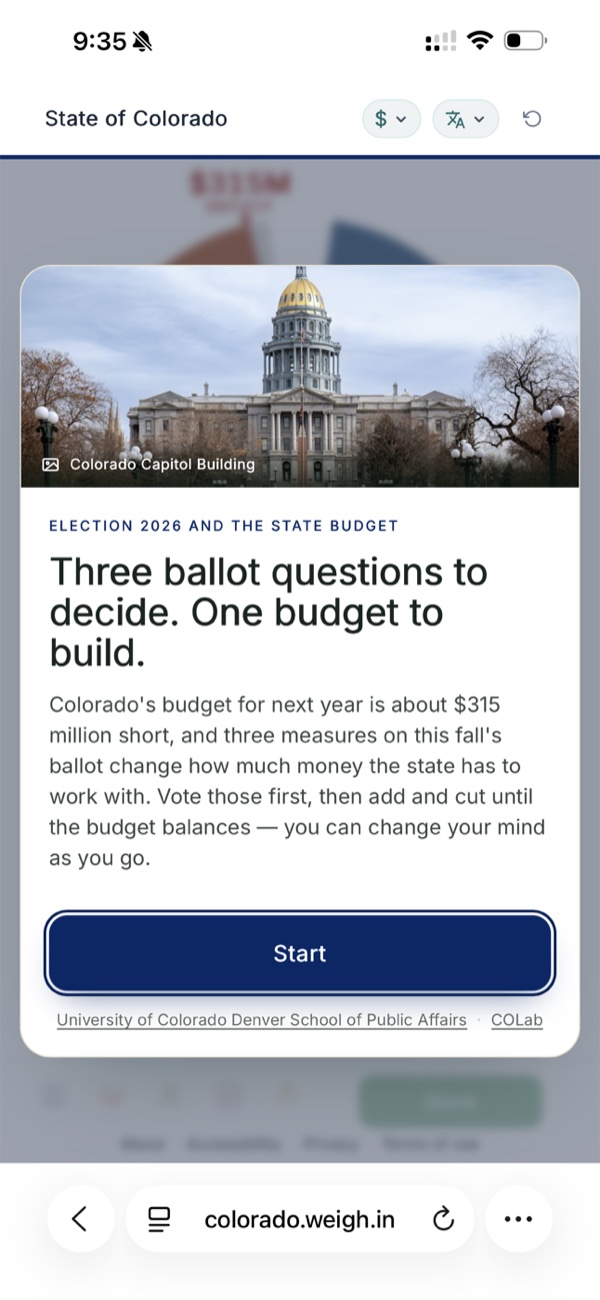
Colorado Tradeoffs
The clearest picture of how we work is a live engagement. Here is one running at state scale.
A statewide proof of concept: simulation, deliberation, and reporting, before the 2026 ballot.
Colorado Tradeoffs is a partnership between COLab, the Colorado News Collaborative (a network of nearly 200 newsrooms), Weigh In, and the University of Colorado Denver School of Public Affairs.
In 2026, Coloradans face ballot measures on tax restructuring against a $315 million structural deficit. Under Colorado's constitution, voters are the legal decision-makers on tax and spending questions, yet they typically arrive at the ballot without the tools needed to make such consequential decisions. Colorado Tradeoffs will put those actual fiscal choices in front of 50,000 residents, in English and Spanish, through interactive simulation and online deliberation before ballots are mailed, with a statewide results report before Election Day.
What it looks like on a real decision
From the first conversation to results in front of council, here is what actually happens, who does what, and what your team is asked for at each stage.
-
Stop 1
Understand
We learn the budget issues you're facing, your real constraints, and who you need to hear from.
-
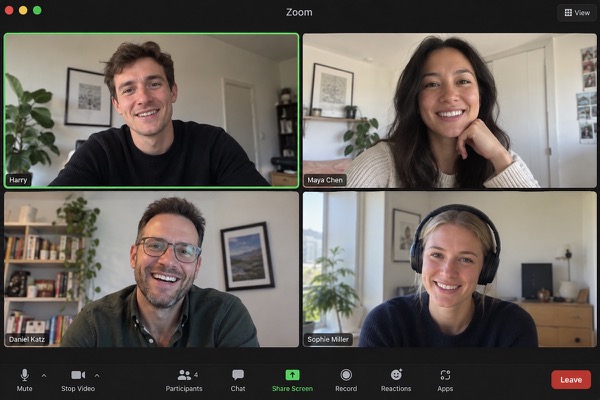
Stop 2
Strategize
We design the engagement and recommend which tools fit the question at each stage of the process.

-
Stop 3
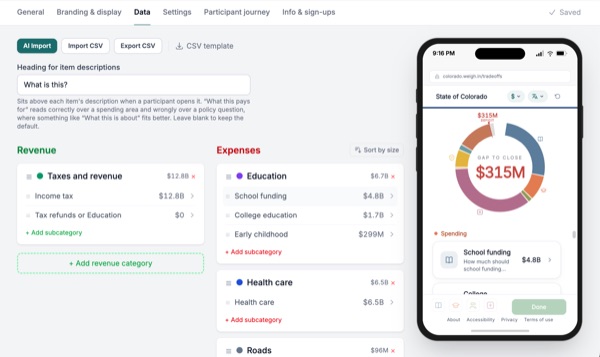
Build
We configure each tool on your jurisdiction's actual budget: your funds, your line items, your numbers.
-
Stop 4
Monitor
We watch participation while it's live and keep it healthy.
-
Stop 5
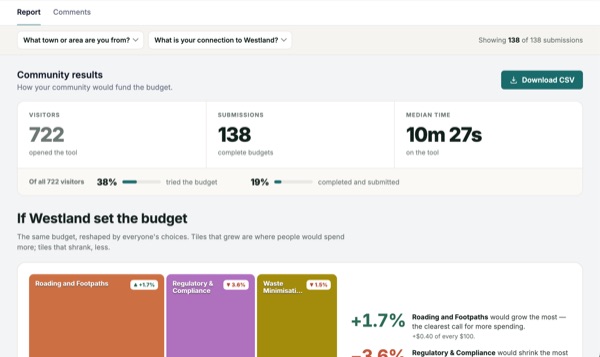
Report
We deliver a clear summary of what an informed community chose, ready for council, the board, or the public.

Built on a decade of public
budget engagement.
Weigh In is a public benefit corporation. It was founded by the creator of Balancing Act, the budget simulation platform used by more than 150 local governments and school districts across the US, Canada, and four other countries, selected for the GovTech 100 six years running, a two-time ELGL Haverford Award winner, and named to Fast Company's list of World Changing Ideas.
More about usMost engagement asks people what they think. We focus on what they would actually do, and why. Better decisions start with better input.

The hard problems we solve.
Four decisions that recur in every jurisdiction, at four different points in the cycle. Each one needs a different kind of answer from residents. Pick the problem you are facing.
We have more good ideas than money, and we need to know what matters most.
Capital plans, strategic priorities, council goals: every option is defensible on its own, and together they exceed what you can fund. Someone has to decide what comes first, and that order needs to survive contact with the public.
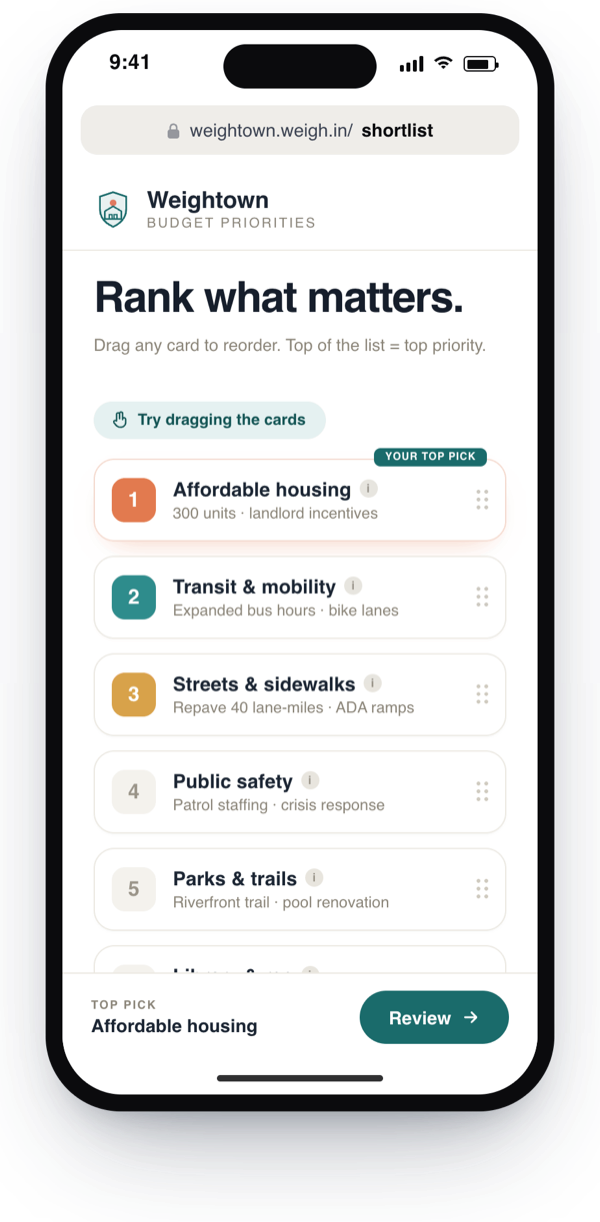
Shortlist. Residents rank the competing options against one another under a real limit. The most flexible tool in the suite, it works for any decision where good options compete.
- Each option carries a cost or value, ranked within a fixed limit: real trade-offs, not a wish list
- Outputs a clear collective ranking, not vote counts
- Works for capital plans, strategic plans, and council or board priorities
We have to cut, or raise revenue, and we have no mandate for either.
A structural deficit, a bond question, a tax-rate election. The decision is consequential, contested, and whatever you choose will need to be defended in public. Consultation that collects opinions will not help you here.
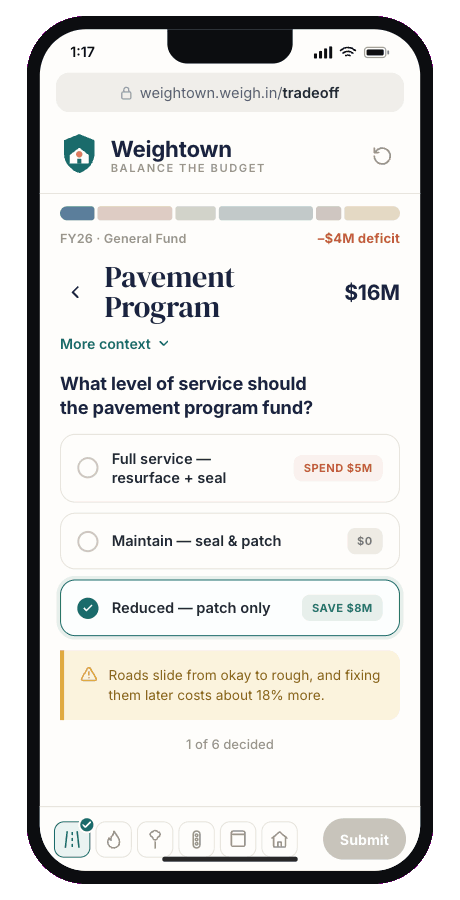
Tradeoff. Residents balance the budget under your real constraint. Every dollar added requires a corresponding cut or new revenue, so what you get back is not a preference, it is a decision that adds up.
- Live deficit or surplus gauge set to your real targets
- Every choice shows its consequence before residents commit
- Forced balance: every submitted budget actually works
The draft is out. Residents should get a chance to understand it and respond.
Sometimes you do not need residents to rebuild the budget. You need a straight answer on how the community feels about the shape of it, across the big categories, while there is still time to respond before adoption.
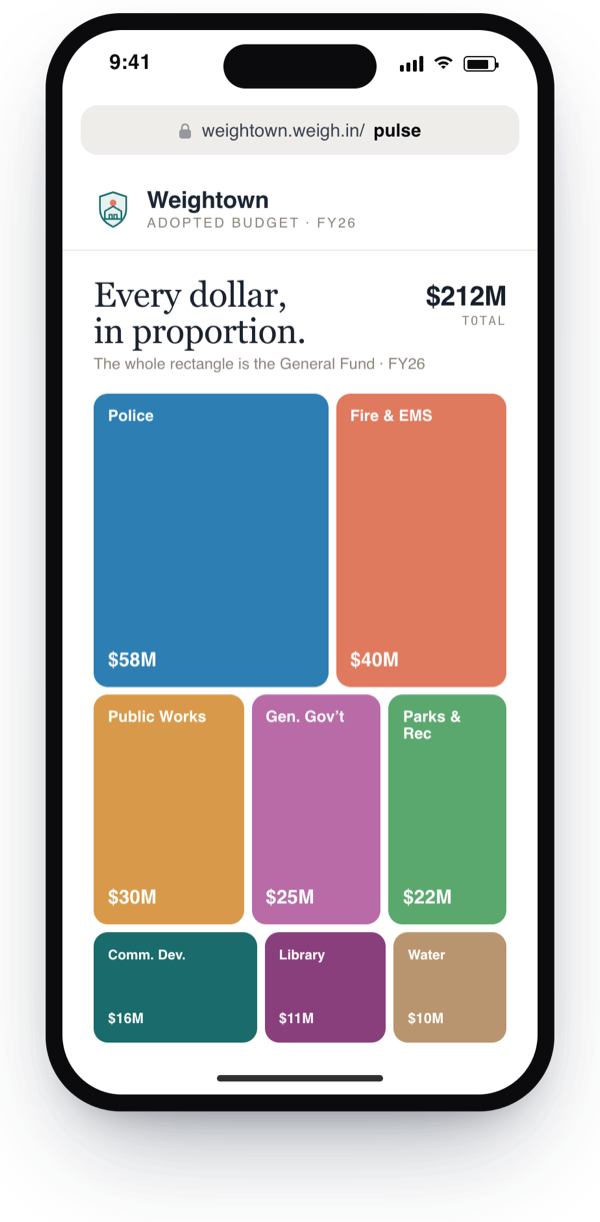
Pulse. A pulse check on a proposed budget. Residents see spending in broad categories rather than line items, and register whether each feels about right, too high, or too low.
- Every category shown in proportion, so the whole budget is legible at a glance
- Bounded response: sentiment on the shape of the budget, not a rebuild
- Fast turnaround between draft and adoption
Residents have no idea what they already pay for.
Every budget conversation starts from a false premise: that taxes are large, arbitrary, and go somewhere unspecified. Until people can see what they actually contribute and what it buys, the debate never gets to the real question.
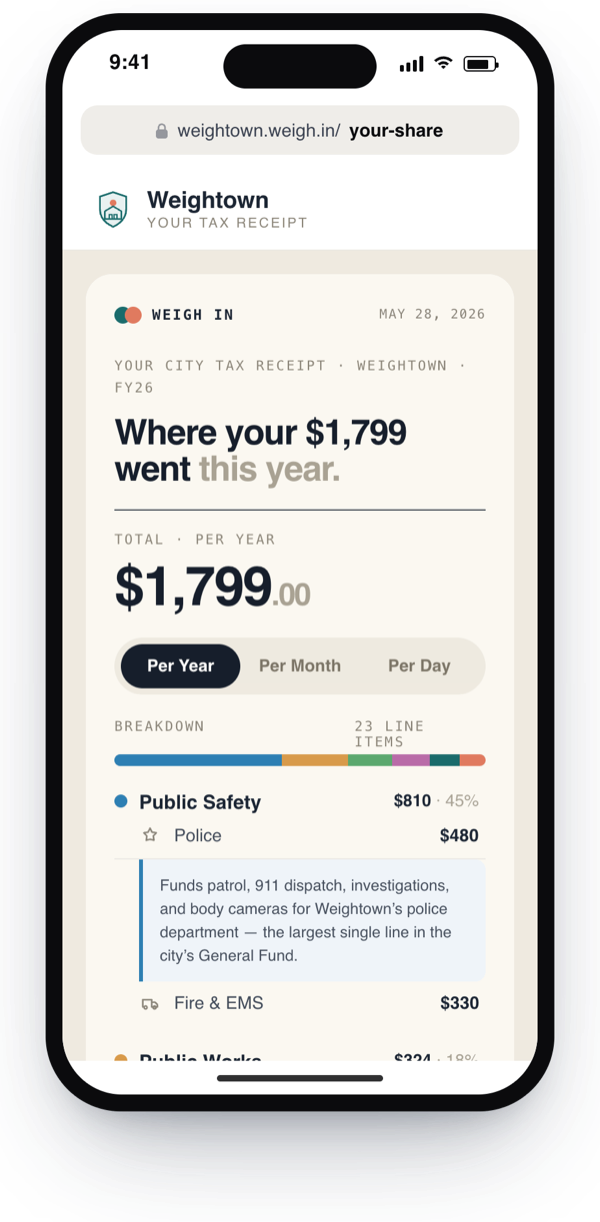
Your Share. A personalized taxpayer receipt. Residents see where their own tax dollars went, by service category and income bracket. The honest starting point for everything else.
- Estimates taxes paid from your jurisdiction's actual rates and tax types
- Per-household receipt by income and filing status
- Breakdowns per year, per month, and per day
- Embeddable on your website and in tax-bill mailers
Why it's not a survey.
The constraint is what does the work. Three design principles separate these tools from a survey, a hearing, or a comment portal. They reach far more residents than a survey sample, and respect them enough to ask them to solve the problem, not just react to it.
Your jurisdiction's actual numbers.
Real budget, real revenue, real targets. Real numbers signal to residents they are being asked to help solve a real problem, and they make the resulting input usable in actual budget work.
You can't add without giving something up.
Every dollar added has to come from a cut or new revenue. Working within a fixed total is what produces judgment, instead of another flavor of opinion.
The Three C's.
What each program does, what it costs, and what happens if you fund it, cut it, or change it: Context, Cost, Consequences. Enough grounding to choose with confidence, not to overwhelm.
If you already run priority-based budgeting or budgeting for outcomes, think of this as the resident side of that work: the same priorities, tested with the people who pay for them.
Add deliberation,
and it becomes
Immersive Deliberation.
The simulations tell you what an informed community would fund. Deliberation tells you what happens when those residents talk it through.
Small groups meet online, discuss the choices they made, hear perspectives they hadn't considered, and often revise their thinking. We measure how positions move before and after, so you see not just the outcome but where minds changed, and why.
This is the methodology we call Immersive Deliberation: simulation and deliberation together: the step from raw opinion to considered judgment.
And it scales: Stanford's Deliberative Democracy Lab finds online deliberation can be as effective as in-person sessions, at a fraction of the cost.
James Fishkin's Deliberative Polling at Stanford finds it can produce depolarizing shifts of as much as 40 points on divisive issues, with effects that persist in how people vote about a year later.
Fishkin, Siu, Diamond & Bradburn, "Is Deliberation an Antidote to Extreme Partisan Polarization? Reflections on America in One Room," American Political Science Review (2021)


Extend reach through community partners
Engagement goes further when it's hosted by partners residents already trust. For interested communities, we can do an assessment to see whether the conditions are right for a local partner (a community organization or a newsroom) to take on a role, extending the engagement so it's community-wide, not just a government program. Colorado Tradeoffs is that model at statewide scale.
Built for budgets, and
wherever options compete.
Budgets & financial decisions
- General-fund operating budgets
- Capital budgets & bond elections
- Sub-department budgets: police, parks, public works, libraries, transportation
- School-district & special-district budgets
- Tax-rate elections & revenue ballot measures
Beyond the budget
- Strategic plans & council/board priorities
- Capital-improvement prioritization
- Facility & service-level choices
- Program & project trade-offs
Whatever the decision, we choose and configure the right tool for it. You never manage software.
See what better budget engagement looks like.
We'll walk you through our methodology and technology, discuss whether deliberation or involving other organizations is appropriate, and sketch what a deployment would look like for your next budget cycle, bond question, or tax-rate election.
Your demo request is in.
Thanks, we'll be in touch shortly. Feel free to keep exploring in the meantime.
or reach us at hello@weigh.in